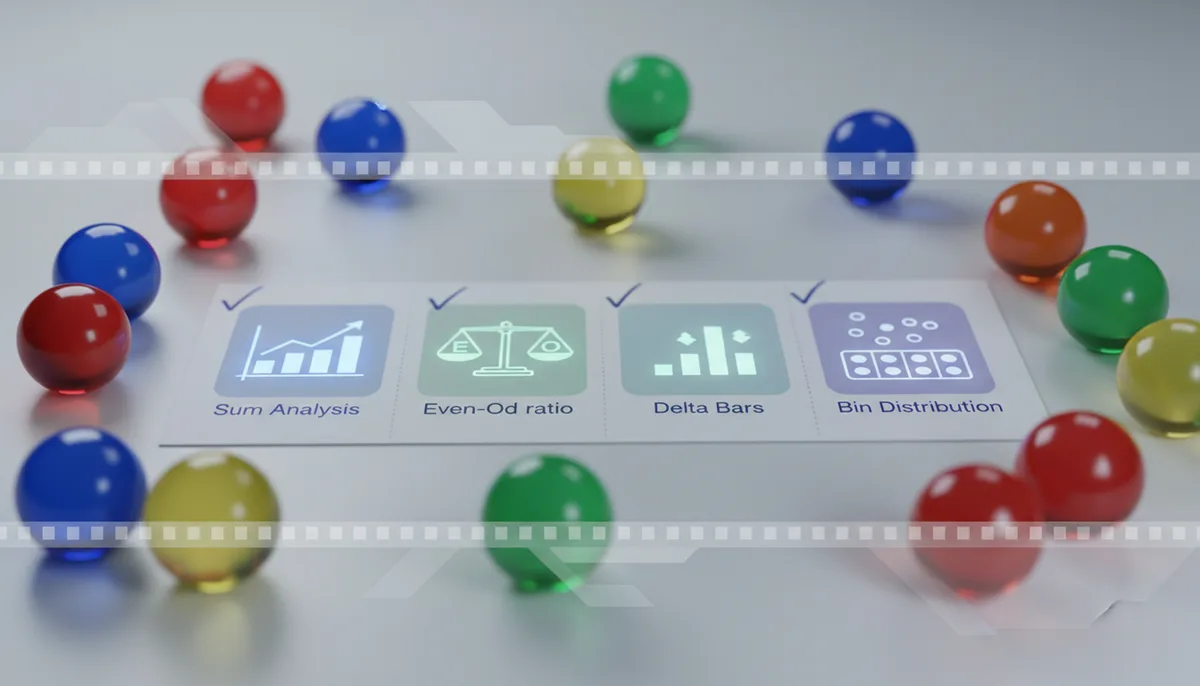
You have 5 numbers in hand for the French Loto, and you are not sure whether to take them to the counter. Intuition might tell you that 4-5-6-7-8 is an "unlucky" ticket while 3-14-22-31-44 is "normal", but intuition with numbers is unreliable. Statistical filters work more precisely and objectively — simple rules that compare your combination against the historical distributions of the archive. The site brings together six tools for this, and together they take five minutes to run. One important caveat upfront: filters do not raise your chance of winning, but they help you avoid an obviously "junk" ticket and reduce the odds of sharing a prize with a crowd if you do get lucky.
Why filter a combination
A filter is not a way to guess the numbers — it is a way to verify that your numbers resemble those that have historically won. The distinction matters. Your odds of the jackpot are the same 1 in 19,068,840 regardless of which numbers you pick. But the size of the prize you would receive if you win depends on how many other people chose the same combination.
Common "recognizable" tickets (consecutive numbers, all even, all from the first ten) are bought by tens of thousands of players at once. If such a combination wins, the prize is split among them into microscopic shares. A combination that passes all six filters lands in the "normal pool" — where random combinations with a typical distribution live — and you would share the prize with far fewer people.
Another reason to apply filters is the discipline of choice. They give you an objective criterion for rejecting clearly strange combinations and settling on an "unremarkable" one. This is especially useful within a playing strategy, where the repeatability of the process matters more than a single "lucky" bet.
Filter 1. Sum of the numbers
The strongest of the simple filters. The sum analysis section shows a histogram of the sums of every winning draw. For the French Loto the distribution is bell-shaped, and roughly 80% of draws have a sum in the 90-160 range. The theoretical center is 125 ((49 + 1) / 2 × 5), while the edges — 15 (1+2+3+4+5) and 235 (45+46+47+48+49) — occur vanishingly rarely.
The difference is not about the jackpot probability. Every combination has the same chance. But there are millions of times more combinations with a sum near 125 than combinations with a sum of 15 or 235. This is a simple consequence of the central limit theorem: the sum of random numbers concentrates near the mean.
For multi-drum lotteries such as the South Africa PowerBall there is a separate tool — sums by drum — which shows them for each drum individually. The two drums differ: the five main numbers are drawn from 1-50, while the bonus ball comes from a separate 1-20 drum, so their sum ranges are not comparable.
A practical rule: if the sum of your combination falls within the central 60% of the distribution (for French Loto roughly 95-155), the ticket looks "normal". If it is outside that, you should probably redistribute the numbers.
Example. The combination 3-7-12-18-25 gives a sum of 65 — the lower edge. Replacing 3 with 24 raises the sum to 86, closer to the typical range. The combination 33-37-40-43-44 gives 197 — clearly above normal. Replacing 44 with 12 brings the sum down to 165 and still keeps it inside the acceptable zone. The sum filter is flexible: it does not require hitting the exact center, only avoiding the extremes.
Filter 2. Parity: 2-3 even out of 5
The second strongest filter. The even/odd distribution page shows how the proportions of even and odd numbers are spread across winning draws. For the French Loto:
3 even / 2 odd or 2 even / 3 odd — ≈ 32% each.
1 even / 4 odd or 4 even / 1 odd — ≈ 15% each.
0 even / 5 odd or 5 even / 0 odd — about 3% each.
In total, about 94% of winning tickets have 2-3 even numbers out of 5. "All even" or "all odd" combinations do occur, but radically less often. This is not due to a "drum rule" but to elementary combinatorics: with 24 even and 25 odd numbers in the 1-49 range, monochrome combinations are few relative to mixed ones.
A practical rule: if your combination has exactly 2 or 3 even numbers — the filter is passed. If it has 0, 1, 4 or 5, you are betting on a rarer event. This does not mean such a combination will lose; it means you have voluntarily chosen a scenario that historically delivers one prize every dozen-plus draws. For other lotteries the proportions are shifted slightly. In the US Powerball the optimum is 2-3 even of the 5 main numbers; in MillionDAY — also 2-3 even of 5. The tool shows the exact distributions for each specific lottery.
Filter 3. Delta: gaps between adjacent numbers
The delta analysis section shows the differences between adjacent numbers in a combination after sorting. For example, for the combination 3-9-17-22-36 the deltas would be 6-8-5-14.
The historical distribution of deltas in the French Loto has a mean of about 10 and a standard deviation of about 5. Combinations with a "clustered" structure (for instance 4-5-6-7-8, where every delta equals 1) occur extremely rarely, simply because there are very few of them in absolute terms. Combinations with a "stretched" structure (1-13-25-37-49 with deltas 12-12-12-12) are also atypical.
A convenient check: the total delta (the difference between the largest and smallest number) — for French Loto it is usually 30-45. If yours is 48 or 5, those are extreme values, of which there are few in the archive.
The delta filter is especially good at weeding out "patterns" that look visually appealing (arithmetic progressions, numbers from a single ten) but are historically rare. Example: the combination 7-14-21-28-35 is an arithmetic progression with a step of 7; the max − min difference is 28 and falls within the norm for the total delta. But the internal deltas are all identical (7-7-7-7), and such uniformity appears in archives in less than 0.1% of draws. The delta analyzer catches this through the standard-deviation statistic: in a typical draw it is around 4-5, in an arithmetic progression — 0.
Filter 4. Bins: distribution across ranges
The idea of the "Number bins" section is to split the lottery's overall number range into equal bins and check that your selection does not concentrate in one of them. For the French Loto it is convenient to split the range into three bins of roughly 16-17 numbers: 1-16, 17-33, 34-49.
In winning French Loto draws most combinations have 1-2 numbers from each bin — distributions like 2-2-1, 1-2-2 and 2-1-2 account for the bulk of draws (around 60% combined). Combinations where all 5 numbers fall in a single bin (for example only 1-16) occur in less than 1% of cases. Again, this is not a ban but a statistical description.
In practice: count how many of your numbers land in each of the three ranges. If the distribution is 2-2-1 or close to it (1-2-2, 2-2-1, 2-1-2, 1-1-3) — the filter is passed. If all 5 are in one bin — too crowded.
Filter 5. Min-Max: the range boundaries
Two tools cover this filter: the ball min/max section shows the distribution of the minimum and maximum number in a draw, while the min/max sum table shows their average across the archive.
In the French Loto the average minimum number is around 7-8 and the average maximum is around 42-43. This means that in a typical draw the smallest ball is somewhere in the first ten and the largest is near the end of the fourth ten. A combination where the minimum number is 24 (everything in the upper half), or where the maximum is 16 (everything in the lower half), is atypical.
A practical rule: your combination contains at least one number from the first third (1-16) and at least one from the last third (34-49). If it has none, the combination is skewed toward one edge of the range and falls into the marginal 5-10% of draws.
Filter 6. Consecutive numbers
The sixth filter is not a separate section but a simple rule that is often applied after the previous ones. No more than two consecutive numbers. Combinations with 3+ in a row (for example 5-6-7-22-44 with 5-6-7) do occur, but rarely — about 5% of French Loto draws. Combinations with 4+ in a row are under 0.5%.
This filter conveniently complements the delta analysis: delta catches "clustered" numbers through statistics, while the consecutive rule does it through a simple count. Together they cut off the visually "obvious" patterns that share the prize with a large number of players.
Filter | Tool | Rule for French Loto | % of archive passing the filter |
|---|---|---|---|
Sum | Sum in the 95-155 range | ~80% | |
Even/odd | 2-3 even out of 5 | ~89% | |
Delta | Max − min difference: 30-45 | ~75% | |
Bins | At least one number in each third | ~85% | |
Min-Max | Min ≤ 16, Max ≥ 34 | ~78% | |
Consecutive | Simple count | No more than 2 consecutive | ~95% |
If your combination passes all six, it lands in the "normal pool" — the subset of combinations that covers 60-70% of historical draws and shares the prize with far fewer players. The odds of winning stay exactly the same — the combinations formula does the work, and it cannot tell "pretty" combinations from "ordinary" ones.
The percentage in the table shows what share of the archive passes each filter on its own. Passing all six together is a stricter criterion. By an estimate on the French Loto archive, only about 30-40% of draws pass all six filters at once — but that is precisely the "typical middle", where your combination meets the fewest competitors for the prize. Combined with a wheel or pair analysis, the filters give a double discipline: the numbers are chosen deliberately and the combination has passed a structural check.
Checklist for your ticket
Sum in the central 60-70% of the distribution (for French Loto — 95-155).
Even/odd: 2-3 even out of 5. 0/5 and 5/0 are marginal cases.
Delta (max − min): 30-45. Combinations that are too "clustered" or "stretched" occur rarely.
Distribution across ranges: at least one number in each third (1-16, 17-33, 34-49).
Min and Max: minimum no higher than 16, maximum no lower than 34.
No more than 2 consecutive numbers in the combination.
If the ticket passed all six — play it, do not second-guess. Filters do not guarantee a win, but they put you in the "normal pool", where the prize is split among fewer players.
If some filter is not passed — you do not necessarily have to drop the ticket. Tweak a couple of numbers: swapping one for a number from the needed range usually pulls the whole combination back into the norm.